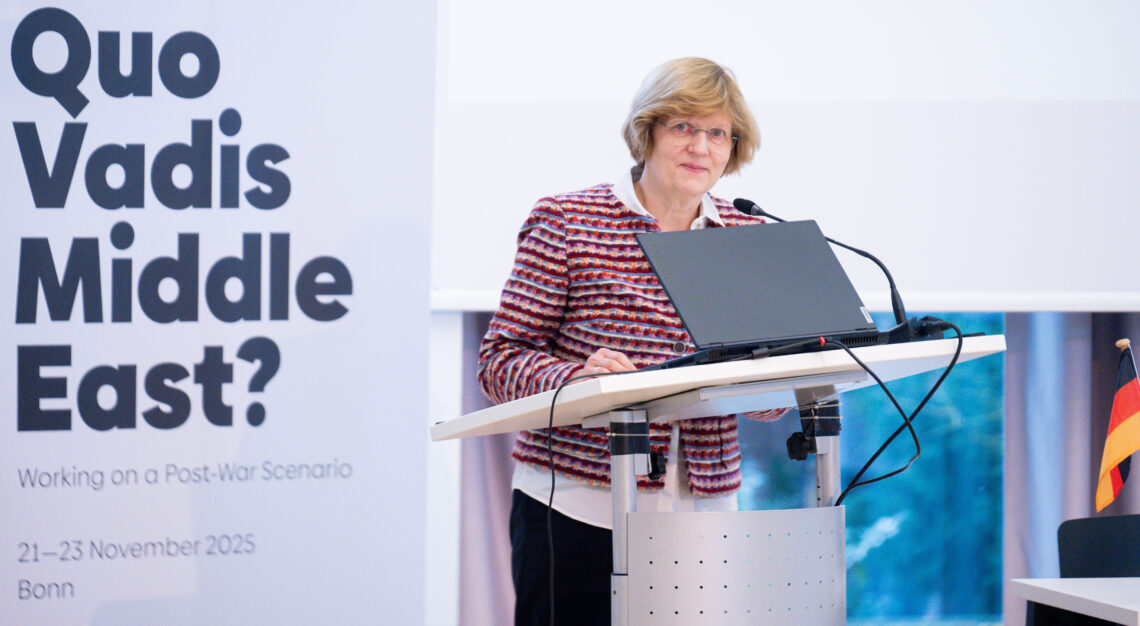
Christine Schirrmacher speaks at the ‘Quo Vadis Middle East’ conference organised by the Institute for International Cooperation, Technological Diplomacy and Communication
(Bonn, 22.06.2026) The conference ‘Quo Vadis Middle East: Working on a post-war scenario #5’, held at the University Forum in Bonn, brought together leading figures from politics, diplomacy, academia and civil society for the fifth time to discuss sustainable post-war visions for the region and to identify pathways to regional stability and long-term peace.
In her keynote address, Christine Schirrmacher, Professor of Islamic Studies at the University of Bonn, spoke about the search for a viable political model in the Middle East, which she described as a key challenge for the sustainable establishment of stability in Middle Eastern societies. The Arab revolutions in the MENA region from 2011 onwards, and the political reforms demanded at the time by millions of protesters, had already highlighted the urgent need to find a viable political model and a form of government accepted by a majority. Since the protesters—from Morocco to the Arabian Gulf—had at that time, on the one hand, demanded greater civil liberties, whilst at the same time a majority also rejected a secular state and advocated a legal and social order governed by Sharia law, Western models of democracy offered no alternative. Christine Schirrmacher identified the expansion of women’s rights in the region as a further factor in building stability, equality of opportunity and social reconciliation. As marriage, inheritance and divorce laws in all Arab countries are based on Sharia law, women face significant obstacles in their demands for greater rights.
The ‘Quo Vadis Middle East?’ conference series is an initiative launched in 2023 by the Institute for International Cooperation and Technological Diplomacy (ICI) in Aachen, in cooperation with the Bonn Centre for Reconciliation Research (BZV) and the Centre for Advanced Security, Strategic and Integration Studies (CASSIS) at the University of Bonn. The series was launched immediately following Hamas’s attack on Israel on 7 October 2023 to bring together key stakeholders from politics, academia, business and civil society in the region for a fruitful dialogue, with the aim of developing sustainable post-war scenarios, peace and reconciliation strategies, and regional cooperation. To this end, the social, psychological and economic consequences of the existing conflicts are analysed, the role of Western powers is examined, and opportunities for future stability are identified.
The Institute for International Cooperation, Technological Diplomacy and Communication in Aachen is dedicated to fostering links between academia, politics and practice in order to analyse issues such as technological innovations, conflicts and questions of stability, particularly in the Middle East, Africa, Asia and Europe. It works closely with the University of Bonn, Germany’s most successful ‘University of Excellence’, RWTH Aachen University and other partners.
The Bonn Centre for Reconciliation Research at the University of Bonn is an interdisciplinary research network that brings together over 50 researchers from disciplines such as sociology, cultural anthropology, history, theology, philology, philosophy, literature, media studies, law and political science, to analyse reconciliation processes both empirically and theoretically, particularly in light of current challenges such as Covid-19, climate change, populism and the war in Ukraine. Organisationally, it is based within the Faculty of Philosophy. It is led by the sociologist Prof. Dr Hans-Georg Soeffner as spokesperson, whilst the Argentine Jun.-Prof. Dr Rosario Figari Layus, as junior professor for reconciliation research, serves as executive director.
Downloads and Links
- Photo 1 and photo 2: Christine Schirrmacher delivering her presentation at the ICI conference in Bonn © Benjamin Westhoff
- Photo 3: Quo Vadis Middle East © IIRF/Thomas Schirrmacher
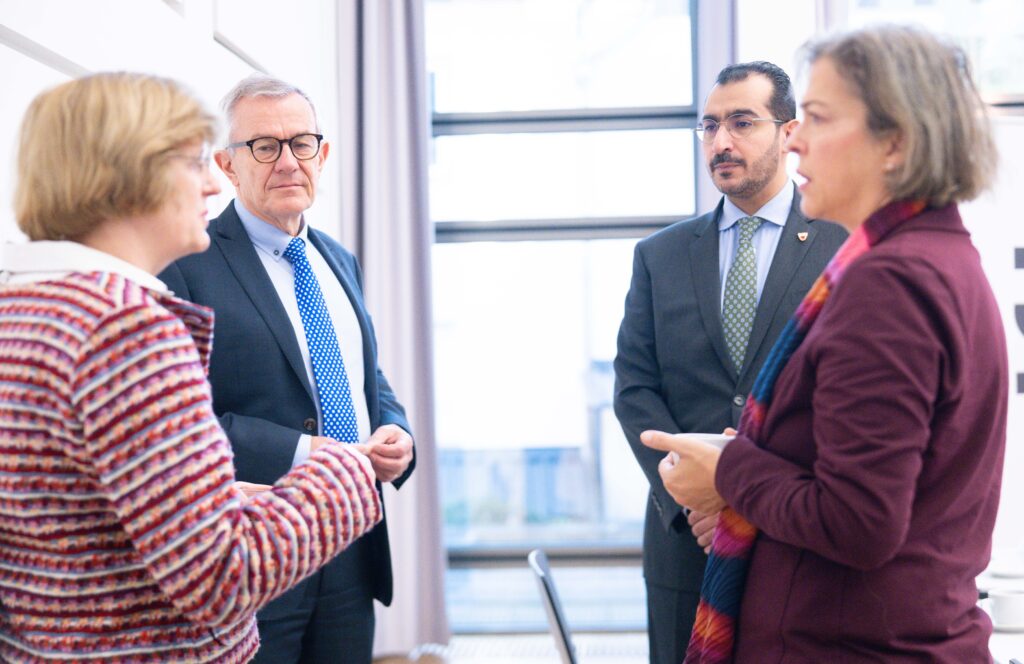
- Photo 4: Christine Schirrmacher in conversation with the Ambassador of Bahrain, H. E. Ahmed Ebrahim A. Rahman Alqarainees © Benjamin Westhoff
- Website of the Institute for International Cooperation, Technological Diplomacy and Communication: https://ici-institute.de
- ICI contribution to the event ‘Working on a post-war scenario’: https://ici-institute.de/veranstaltungen/working-on-a-post-war-scenario-5
- Report by the Essen Institute for Cultural Studies: https://kulturwissenschaften.de/?p=9646

