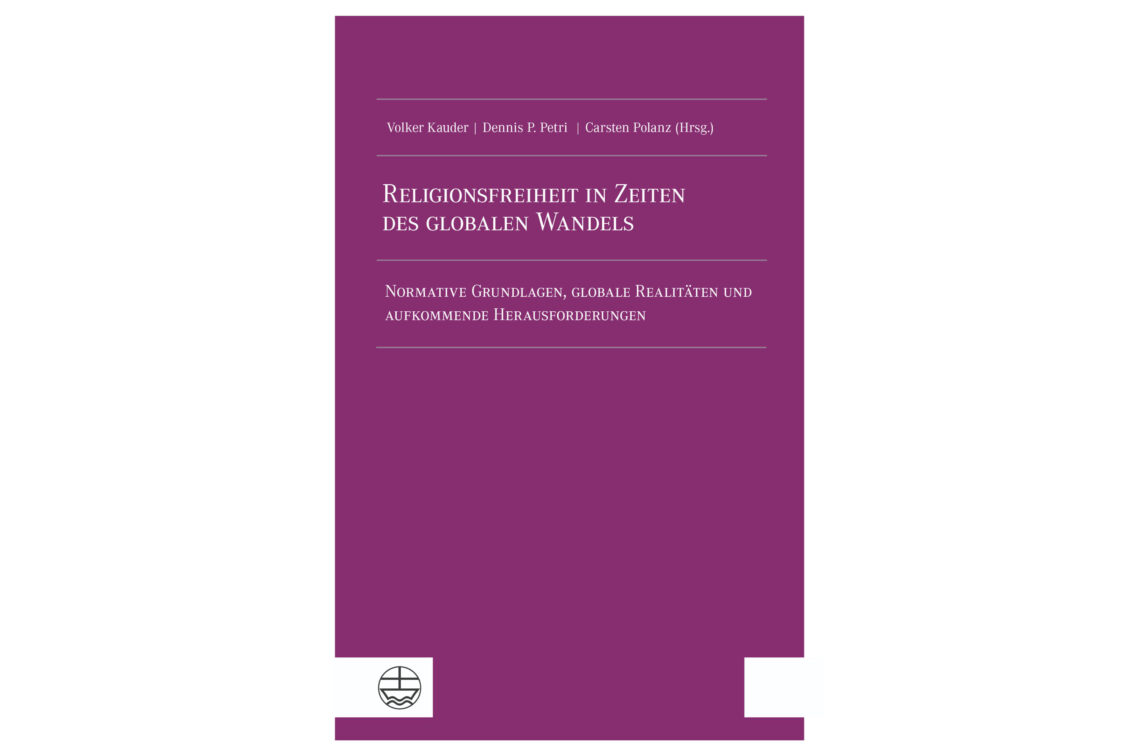
(Bonn, May 18, 2026) The book ‘Religious Freedom in a Changing World’ (‘Religionsfreiheit in Zeiten des globalen Wandels’) brings together analyses of the normative foundations, global realities, and current challenges facing religious freedom. Based on a symposium held at the Giessen School of Theology (FTH) in 2025, the work offers a blend of academic research, practice-oriented approaches, and personal reflections.
The three editors of the volume alone reflect this blend and breadth very well:
- Prof Volker Kauder is an honorary professor of political ethics and religious freedom at the Giessen School of Theology. From 2005 to 2018, he served as parliamentary secretary and chairman of the CDU/CSU parliamentary group in the German Bundestag, where he was strongly committed to global religious freedom.
- Prof Dr Dennis P. Petri is Director of the International Institute for Religious Freedom (IIRF) and, as a Dutch-Costa Rican political scientist and professor of International Relations at the Latin American University of Science and Technology in Costa Rica, conducts research on religious freedom, democracy, and politics in Latin America.
- Dr Carsten Polanz is a lecturer in Islamic Studies at the Giessen School of Theology and a research associate at the International Institute for Religious Freedom, where he studies intra-Muslim debates on secularism and religious freedom.
Below are the authors and their contributions divided into the book’s three sections.
Academic Discourse
- Dennis P. Petri examines the strengths and weaknesses of existing instruments for measuring religious freedom, focusing particularly on ‘hidden’ violations and proposing concepts of human security as a complement.
- Christof Sauer and Werner N. Nel analyse the conceptual diversity of ‘persecution’, highlighting the difference between legal, sociological, and theological perspectives to avoid inflationary or reductionist usage.
- Christoph Raedel criticises the influence of identity politics, which creates tensions by dividing society into perpetrator and victim groups and puts pressure on religious freedom through anti-discrimination laws.
- Janet Epp Buckingham examines the ‘Big Chill’, in which secular states—using Canada and Europe as examples—increasingly push religion into the private sphere in the name of state neutrality.
- Carsten Polanz explores the role of religious freedom in the public sphere through the lens of intra-Muslim discourses, in which liberal approaches clash with the traditional power claims of umbrella mosque organisations.
- Christine Schirrmacher addresses the debate over freedom of belief in Muslim-majority societies, where doubts about Islam are often viewed as a threat to the state, making it extremely difficult to change one’s religion.
- Meiken Buchholz demonstrates how the ideal of patriotism is used in China to influence Christian decisions of conscience and lead believers into identity conflicts between loyalty to the state and faith.
Practical Application
- Thomas Müller analyses the situation of Indian Christians under the BJP government, where Hindutva ideology, hate speech, and strict anti-conversion laws are steadily increasing pressure on religious minorities.
- Ronald MacMillan presents a seven-step model for identifying ‘creeping’ persecution at an early stage and demonstrates its application using the example of Christian tribal groups in India.
- Anna E. Hampton develops a ‘theology of risk’ designed to help believers in repressive environments make strategic and responsible decisions between a willingness to suffer and necessary prudence.
Personal Reflection
- In an interview, Heiner Bielefeldt and his interviewer David Giesbrecht discuss religious freedom as a constitutive component of human rights and warn against the instrumentalisation of human rights as an ideological weapon.
- Thomas Schirrmacher and his interviewer Carsten Polanz examine anti-Semitism, whose roots they trace to antiquity, religious traditions, and modern extremist ideologies, and which they see as the sole commonality of a long Christian, a long Islamic, and a long secular tradition that converge today.
- Stephan Holthaus reflects on the Christian willingness to suffer and laments a widespread aversion to suffering among Christians in affluent Western societies, which he argues has lost sight of the biblical understanding of following Jesus.
Bibliographic information
- Volker Kauder, Dennis P. Petri, Carsten Polanz (eds.). Religionsfreiheit in Zeiten des globalen Wandels/Religious Freedom in a Changing World. Normative Grundlagen, globale Realitäten und aufkommende Herausforderungen. Evangelische Verlagsanstalt, Leipzig 2026. 300 pp. ISBN 978-3-374-08047-2, ISBN E-Book 978-3-374-08048-9. 39 Euro.
Downloads und Links
- Photo 1: Book cover
- Photo 2: Volker Kauder © Bundeskanzler-Helmut-Kohl-Stiftung
- BQ 839 – 19/2025 “Criticism of the intertwining of power politics and religion in Islamic countries – Professor Christine Schirrmacher from Bonn spoke at the Religious Freedom Congress in Giessen”: https://bonn-profiles.net/?p=8419
- BQ 837 – 17/2025 “A call for joint commitment to religious freedom – First symposium on religious freedom at the FTH”:https://bonn-profiles.net/?p=8357
PDF-Donwload
Permalink: https://bonn-profiles.net/?p=12461

