Peace policy in a religiously and historically charged conflict
(Wiesbaden/Bonn, 05.10.2026) Armenian Prime Minister Nikol Pashinyan was awarded the Hesse Peace Prize at the Hessian State Parliament in Wiesbaden on 18 September 2026. The prize, endowed with € 25,000 and awarded by the Albert Osswald Foundation, honours individuals who have made an outstanding contribution to ending or preventing violent conflicts, preventing violence and promoting international understanding.
Diplomacy in the Face of Opposition
President of the Hessian State Parliament Astrid Wallmann stated that the recent progress in the peace process between Armenia and Azerbaijan was among the most significant political developments in the South Caucasus. The award recognised Pashinyan’s contribution to this process and sent a visible signal in favour of understanding and non-violent conflict resolution. Wallmann was represented at the ceremony by Vice-President of the State Parliament Dr Daniela Sommer.
Sommer stressed that abandoning the path of confrontation in a conflict structurally shaped by violence for decades was no easy undertaking. Pashinyan had assumed responsibility and chosen the path of dialogue and diplomacy in order to open up new prospects for Armenia and its people.
Serap Güler: Political Courage and European Orientation
The laudatory address was delivered by Serap Güler, Minister of State at the Federal Foreign Office. She recalled Pashinyan’s career as a journalist and opposition politician, his persecution and imprisonment, and his leading role in the non-violent “Velvet Revolution” of 2018. His political path, she said, had been characterised by courage, steadfastness in the face of opposition, a willingness to assume responsibility and the ability to reconsider his own convictions.
Pashinyan had assumed responsibility in a region where conflict, mistrust and violence had long been part of political normality and had opened up an opportunity for Armenia to shape its future increasingly on the basis of the possibilities of peace. Güler also praised Armenia’s closer partnership with Europe as a commitment to freedom, democracy and the rule of law, and as an expression of Armenian self-determination and sovereignty.
Ingmar Jung: “The Path to Peace Is Rarely the Easy Path”
Hessian Minister of State Ingmar Jung emphasised that peace required courage, perseverance and a willingness to take difficult decisions – particularly when those decisions met with resistance at home. The award, he said, also carried a message extending beyond Armenia: reconciliation rather than confrontation could open a path towards the future.
Jung likewise referred to Pashinyan’s turn towards Europe, which he described as an expression of confidence in Europe, shared values and the strength of European cooperation.
Pashinyan: Peace Must Be Consolidated
Pashinyan himself stated after receiving the award that peace must not be taken for granted. It had to be cultivated, institutionalised and consolidated in such a way that it became stable and irreversible. In his acceptance speech he explicitly paid tribute to Azerbaijani President Ilham Aliyev, stating that Aliyev deserved the Peace Prize as well. He also thanked the populations of both countries for their willingness to support the path towards peace.
Schirrmacher Is the First to Congratulate the Prime Minister after the Ceremony
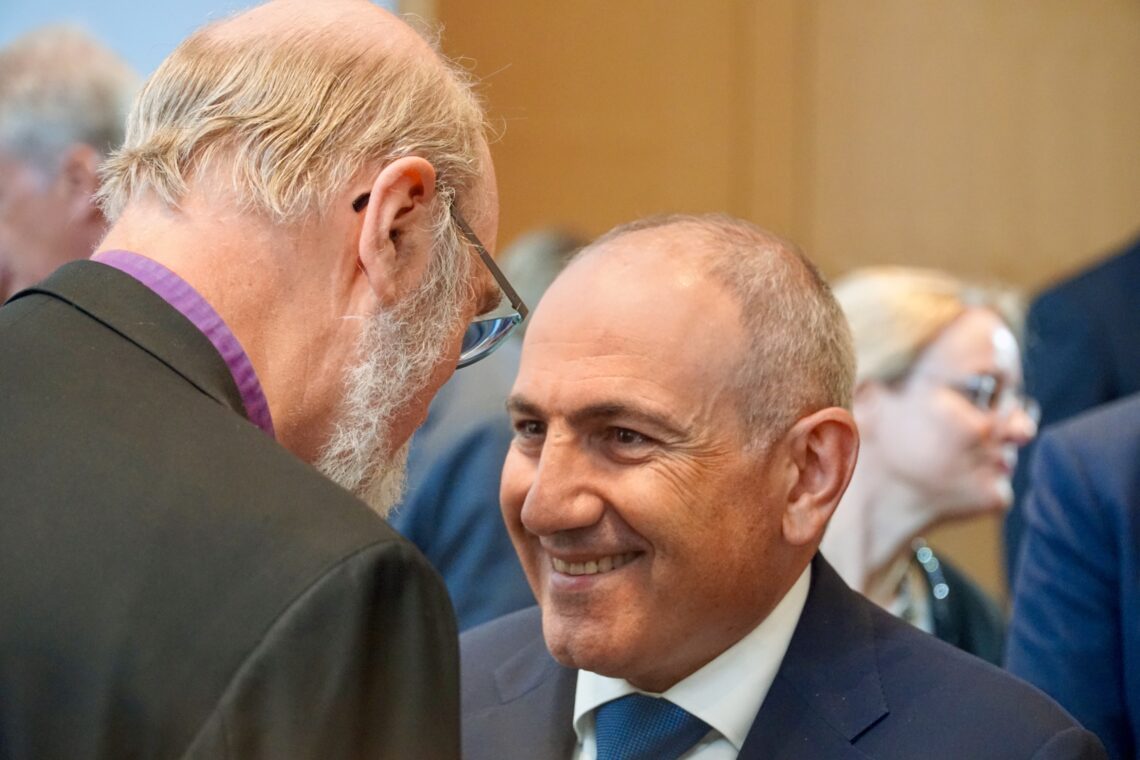
Immediately after the conclusion of the award ceremony, Archbishop Prof. Dr Thomas Schirrmacher, President of the International Council of the International Society for Human Rights (ISHR), was the first guest to congratulate Prime Minister Pashinyan personally. The congratulations developed into a personal conversation.
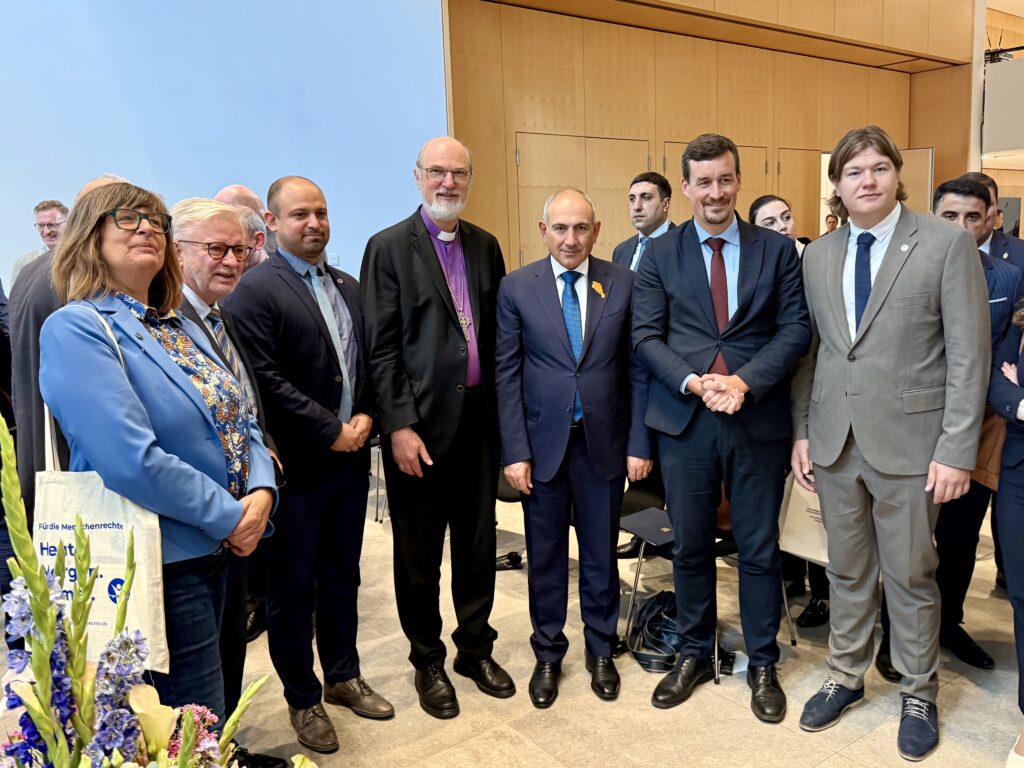
Schirrmacher also introduced Pashinyan to the members of the ISHR delega-tion. Apart from the Armenian delegation accompanying the Prime Minister, it was the largest delegation present at the award ceremony. Its members included ISHR Secretary General Matthias K. Böhning, Dr Carmen Krusch-Grün, member of the International Council and responsible for Eastern Europe, Valerio Krüger, CEO of the German Section, and Artem Kryvulia. About half an hour later, Pashinyan and Schirrmacher had another opportunity for a more extensive personal conversation.
During their conversations, the Prime Minister invited Schirrmacher and the ISHR delegation to visit Armenia. The meeting is expected to take place soon.
The Religious and Historical Dimension of the Conflict
Schirrmacher referred in his conversation with the Prime Minister to his many years of experience in Armenia and Azerbaijan. As an international Christian religious leader, he has repeatedly visited both countries and has experienced how deeply the conflict is charged not only nationally and territorially, but also religiously and historically.
It was precisely against this background that Schirrmacher praised Pashinyan’s decision to silence the weapons and seek a political understanding with Azerbaijan. Since February 2024, no Armenian soldier has been killed as a result of a ceasefire violation.
Schirrmacher also discussed with Pashinyan the fact that the religious and historical dimensions of the conflict make his peace policy particularly vulnerable to domestic criticism. Opponents accuse the Prime Minister of having abandoned the Armenian heritage of Nagorno-Karabakh, and in particular its centuries-old Christian heritage, through his policy towards Azerbaijan.
This must be distinguished, although the two issues partly overlap, from the fundamental dispute between Pashinyan’s government and the Armenian Apostolic Church over the Church’s social and political role. This dispute is taking place at the same time as Armenia is reorienting its foreign policy, moving closer to Europe and increasingly distancing itself from its traditional dependence on Russia.
Schirrmacher particularly thanked Pashinyan for ex-plicitly paying tribute to Pre-sident Aliyev in his accep-tance speech. Given the long history of mutual hos-tility, Schirrmacher regar-ded the public acknowledgement of the other side’s contribution to achieving peace as a remarkable signal.
Background
The Hesse Peace Prize has been awarded by the Albert Osswald Foundation since 1994. Pashinyan, born in 1975 and formerly a journalist, became Prime Minister of Armenia following the “Velvet Revolution” of 2018. Under his government, Armenia has placed greater emphasis on state sovereignty and deepened its relations with Europe. Since 2025, the objective of joining the European Union has had a statutory basis in Armenia.
The ISHR has maintained a section in Armenia for many years. Its areas of work include human rights, democratic structures, media literacy, fact-checking and combating disinformation.
Downloads and Links
- Photo 1: In a personal conversation immediately after the award ceremony: ISHR President Prof. Dr Thomas Schirrmacher congratulates Armenian Prime Minister Nikol Pashinyan on receiving the Hesse Peace Prize © ISHR/Martin Warnecke
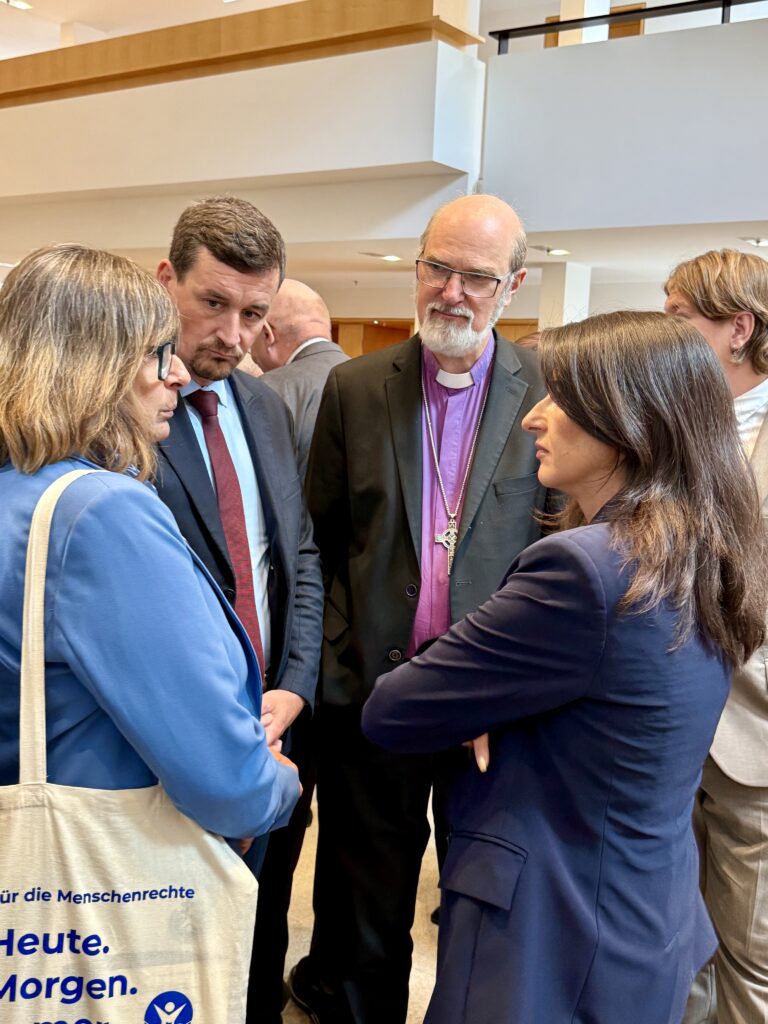
- Photo 2: In conversation on the sidelines of the award ceremony (from left): Dr Carmen Krusch-Grün, Matthias K. Böhning and Prof. Dr Thomas Schirrmacher, members of the ISHR International Council, with Minister of State Serap Güler, who had delivered the laudatory address for Nikol Pashinyan © ISHR/Martin Warnecke
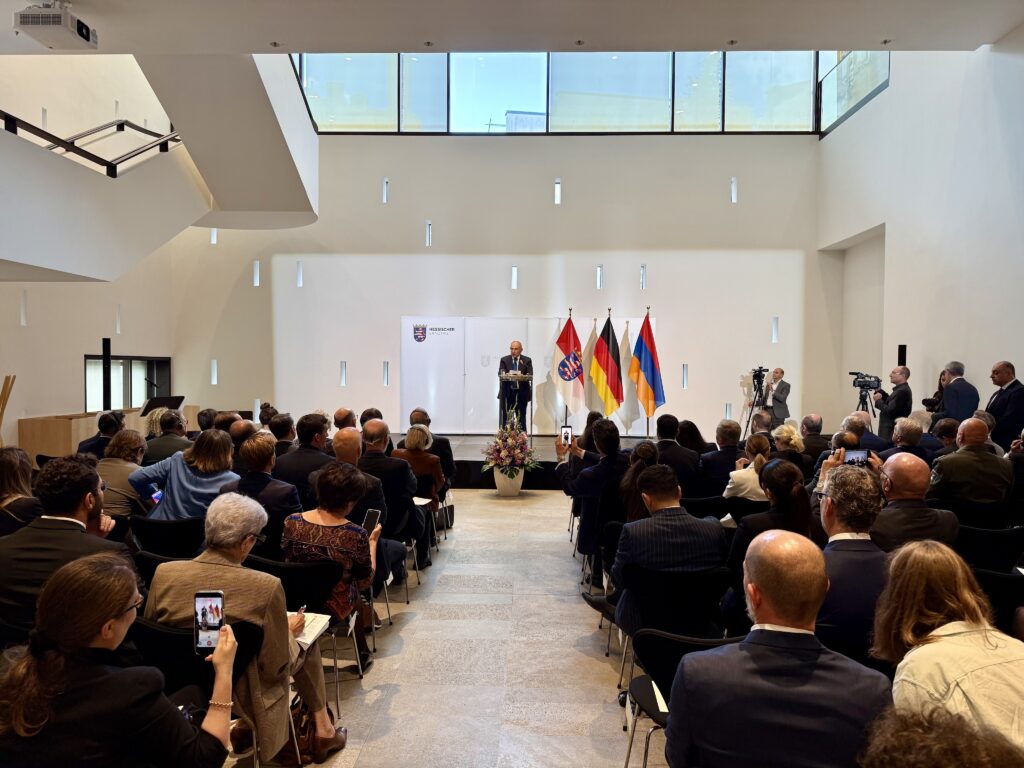
- Photo 3: Armenian Prime Minister Nikol Pashinyan delivers his words of thanks after receiving the Hesse Peace Prize at the Hessian State Parliament in Wiesbaden © ISHR/Martin Warnecke
- Photo 4: Members of the ISHR delegation with Prime Minister Nikol Pashinyan following the award ceremony (from left): Dr Carmen Krusch-Grün, ISHR Eastern Europe Department; MEP Michael Gahler; Valerio Krüger, spokesperson for the German Section of the ISHR; Archbishop Prof. Dr Thomas Paul Schirrmacher, President of the ISHR International Council; Nikol Pashinyan, Prime Minister of the Republic of Armenia; Matthias K. Böhning, ISHR Secretary General; and Artem Kryvulia, ISHR Eastern Europe Department © ISHR/Martin Warnecke
- Photo 5: Prof. Dr Thomas Schirrmacher with Armenian Prime Minister Nikol Pashinyan and ISHR Secretary General Matthias K. Böhning following the award ceremony © ISHR/Martin Warnecke
- Photo 6: Following the presentation of the Hesse Peace Prize (from left): Prof. Dr Thomas Schirrmacher, an attaché to Prime Minister Nikol Pashinyan, Karl Starzacher, former President of the Hessian State Parliament and Chairman of the Board of Trustees of the Albert Osswald Foundation, and Prime Minister Nikol Pashinyan © ISHR/Martin Warnecke
- Hessian State Parliament: “Nikol Pashinyan hat den Weg des Dialogs eingeschlagen” (18 September 2026)
- International Society for Human Rights: “Nikol Pashinyan awarded the Hesse Peace Prize” (21 September 2026)
- Hessenschau: Hessischer Friedenspreis an Nikol Pashinyan im Landtag überreicht
- Frankfurter Allgemeine Zeitung: Hessischer Friedenspreis für Nikol Pashinyan

