
This text has been written with the help of Perplexity.ai and subsequently reviewed.
(Bonn, 04.05.2026) In the German debate on compulsory schooling and homeschooling, Thomas Schirrmacher has played a central role in popularizing and defining the concept of “compulsory education”. While Germany traditionally has strict compulsory schooling, Schirrmacher—particularly since the early 2000s—has argued that the actual goal of the state should not be school attendance as such, but rather the education of the child.
Schirrmacher criticises the fact that compulsory schooling all too often becomes a compulsory school attendance and that politicians often react emotionally as if shaken by the arguments of proponents of compulsory education, but respond less emotionally to the fact that schools are imparting less and less education, and indeed that the proportion of school attendees who, despite having graduated, lack basic educational skills for life is rising.
Schirrmacher is one of the most important German-speaking proponents of the concept of “compulsory education.” Schirrmacher did not invent the term, but he decisively systematised, popularised, and underpinned it with a comprehensive argument.
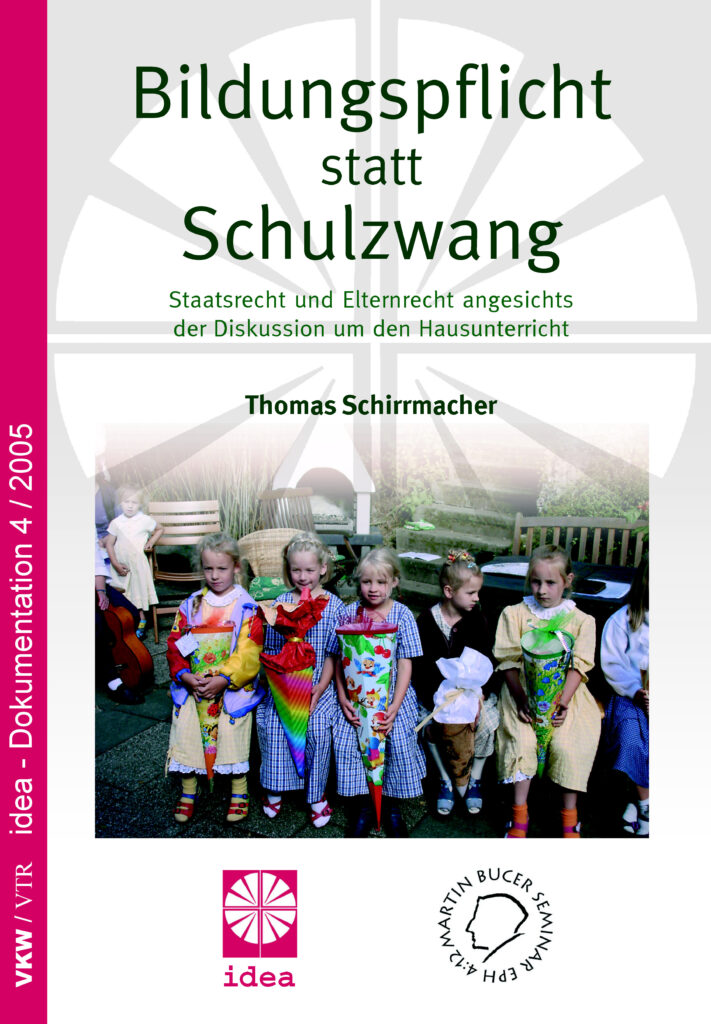 His 2005 work “Bildungspflicht statt Schulzwang” (“Compulsory education instead of compulsory schooling”) represents a programmatic contribution. In it, he develops the thesis that while the state has a legitimate interest in education, the specific form of education (e.g., school or homeschooling) lies primarily, or at least complementarily, within the parents’ sphere of responsibility. Subsequently, the term “duty to educate” became an integral part of certain educational policy and civil society discourses. It also regularly appears in political and journalistic debates as a counter-concept to compulsory schooling.
Schirrmacher thus drew on international models in which homeschooling is permitted and contrasted them with the German legal situation. His argument combines constitutional, pedagogical, and religious-political aspects and is directed against the comparatively restrictive stance in Germany toward homeschooling or other alternatives or combination models to compulsory schooling.
In his relevant works, Schirrmacher clearly distinguishes himself from completely unregulated, state-unsupervised homeschooling as well as from anti-science or anti-education currents within the homeschooling movement. His concept of “educational obligation” is specifically not aimed at abolishing state responsibility, but rather at its readjustment: The state should continue to ensure that children receive a qualified education based on the latest scientific findings, but without mandating attendance at institutional schools.
Schirrmacher emphasises that while parents bear primary responsibility for education, this responsibility remains bound to verifiable standards—such as through performance assessments, exams, or state oversight. In doing so, he deliberately takes a stand against forms of homeschooling that could lead to educational neglect, ideological isolation, or the rejection of scientific findings. His “compulsory education” should therefore be understood as a binding minimum standard for education intended to integrate both individual freedom and social responsibility.
For this reason, Schirrmacher also strongly advocates for hybrid models: homeschoolers who attend school on specific days only, schools that incorporate days of home-based learning, the use of homeschool materials and experiences to combat school refusal—especially for psychological reasons—and so on.
The book by Christin Tellisch and Britta Ostermann, published by his publishing house, “Education, Pandemic, Challenges: Hybridity as a Solution? Opportunities and Challenges for (Inclusive) Educational Processes,” highlights that the pandemic teaches us the importance of hybrid educational pathways and also that schools must now always be prepared for education outside the school building.
Schirrmacher also points out that the state grants many “exceptions” to compulsory schooling, such as the Deutsche Fernschule e. V. for students abroad when no suitable school is available there (including children of German diplomats), students with prolonged hospital stays, students whose families work on ships, students who live too far from the nearest school, and students with high or low academic ability. Schirrmacher argues that “exceptions” can also defuse most requests for homeschooling, since “exceptions” naturally do not circumvent state oversight but are granted by the state on its own terms. After all, while the Basic Law (“Grundgesetz”, Germany’s Constitution) does recognise the state’s duty to supervise education—alongside the parental right also enshrined therein—it does not mandate compulsory school attendance, quite apart from the fact that “school” in the Basic Law (“Grundgesetz”, Germany’s Constitution) refers less to a building and physical presence there than to institutionalised education.
That is why Schirrmacher has also written numerous books and articles on private schools and school education in general and, through his publishing house in the series “Pedagogy in Europe: The Past and The Future”, has published books on boarding schools, Catholic and Protestant private schools, and important educational topics.
Had Schirrmacher written his seminal book today rather than in 2005, he would have had to grapple with the various demands from politicians of the Alternative for Germany (AfD) party, who are calling for a “mandatory education” requirement. Schirrmacher’s “compulsory education” is an approach grounded in human rights and parental rights that welcomes homeschooling only if it enables a better education, which can and must then, of course, be demonstrated to state authorities. As “Commissioner for Religious Freedom of the Evangelical Working Group of the CDU/CSU,” Schirrmacher has on several occasions taken a stand against the AfD’s positions and, during hearings of the Human Rights Committee in the German Bundestag—in each case as an expert nominated by the CDU/CSU parliamentary group—has engaged with the experts proposed by the AfD.
Publications by Thomas Schirrmacher on compulsory education
- Bildungspflicht statt Schulzwang: Staatsrecht und Elternrecht angesichts der Diskussion um den Hausunterricht. Culture and Science Publ.: Bonn & VTR: Nürnberg, 2005. 92 pp. ISBN 978-3-93811-604-8 (VKW) 3-937965-27-0 (VTR), 2005(https://thomasschirrmacher.info/?p=880)
- Thomas Mayer, Thomas Schirrmacher (eds.). Wenn Kinder zu Hause zur Schule gehen – Dokumentation. VTR: Nürnberg, 2004. ISBN 978-3-93337-287-1 (https://thomasschirrmacher.info/?p=11794)
- “Hausunterricht in Deutschland”. Pp. 38–48 in: Thomas Mayer, Schirrmacher (eds.) Wenn Kinder zu Hause zur Schule gehen: Dokumentation. VTR: Nürnberg, 2004.
- “Bildungspflicht statt Schulzwang”. Pp. 199–284 in: Ralph Fischer, Volker Ladenthin (eds.). Homeschooling – Tradition und Perspektive. Systematische Pädagogik 8. Ergon: Würzburg, 2006. ISBN 978-3-89913-482-6
- “Compulsary Education – in Schools Only?”. S. 47–66 in: John Warwick Montgomery (ed.). Homeschooling in America and in Europe: A Litmus Test of Democracy. XXV World Congress of Philosophy and Social Philosophy. Culture and Science Publ.: Bonn, 2012. ISBN 978-3-86269-043-5 (https://vkwonline.com/Homeschooling-in-America-and-in-Europe)
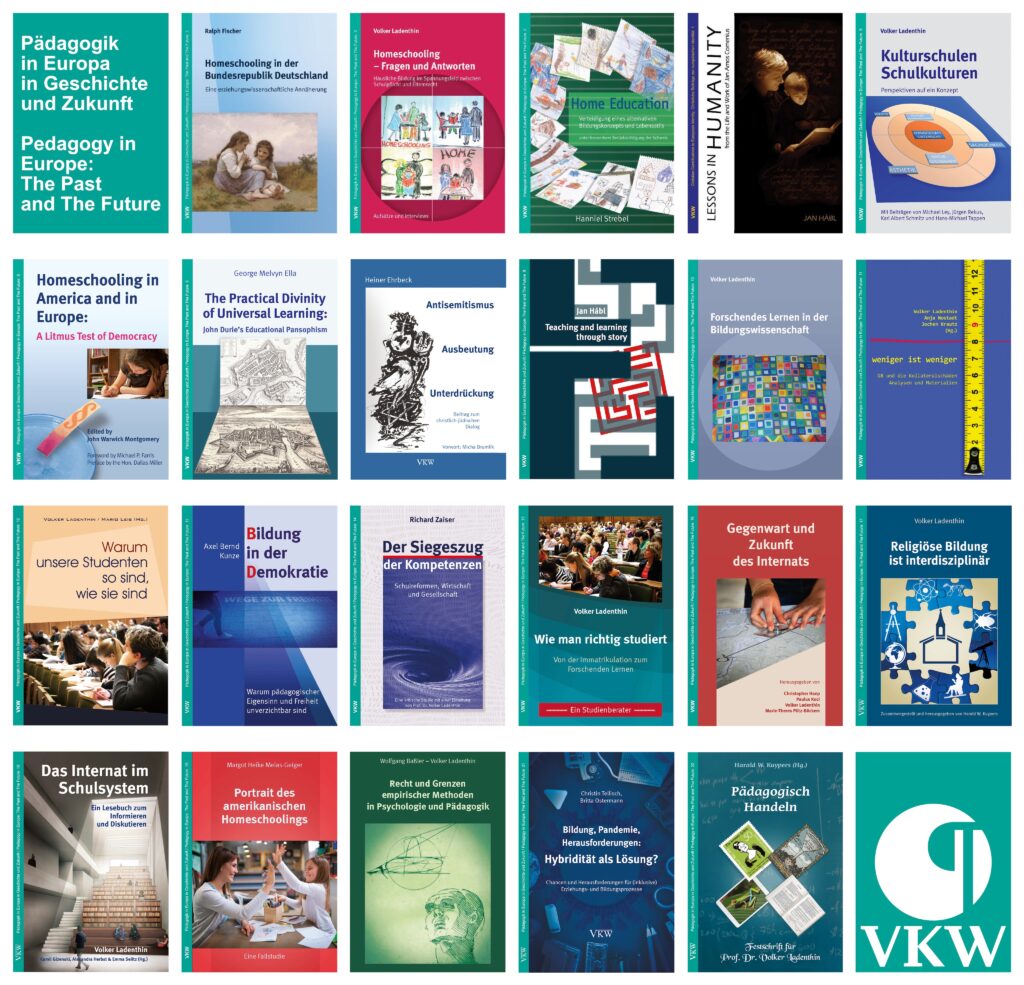
Series “Pädagogik in Europa in Geschichte und Zukunft – Pedagogy in Europe: The Past and The Future” – ISSN 1869-9200 by Culture and Science Publishing
The volumes 1, 2, 3, 6, 19 and 21 are directly relevant to the topic of compulsory education.
- Vol. 1: Ralph Fischer. Homeschooling in der Bundesrepublik Deutschland: Eine erziehungswissenschaftliche Annäherung. 2009. 267 pp. Pb. ISBN 978-3-938116-79-1 (https://vkwonline.com/Homeschooling-in-der-Bundesrepublik-Deutschland)
- Vol. 2: Volker Ladenthin. Homeschooling – Fragen und Antworten: Häusliche Bildung im Spannungsfeld zwischen Schulpflicht und Elternrecht. 165 pp. Pb. 2010. ISBN 978-3-938116-99-9 (https://vkwonline.com/Homeschooling-Fragen-und-Antworten)
- Vol. 3: Hanniel Strebel. Home Education: Verteidigung eines alternativen Bildungskonzepts und Lebensstils unter besonderer Berücksichtigung der Schweiz. 216 pp. Pb. 2011. ISBN 978-3-86269-013-8 (https://vkwonline.com/Home-Education)
- Vol. 4: Jan Hábl. Lessons in Humanity – from the Life and Work of Jan Amos Comenius. (with 4 color and 18 black-and-white images). 160 pp. Pb. 2011. ISBN 978-3-86269-017-6 (https://vkwonline.com/Lessons-in-Humanity-from-the-Life-and-Work-of-Jan-Amos-Comenius)
- Vol. 5: Volker Ladenthin. Kulturschulen Schulkulturen: Perspektiven auf ein Konzept. with contributions by Michael Ley, Jürgen Rekus, Karl Albert Schmitz, Hans-Michael Tappen. 242 pp. Pb. 2012. ISBN 978-3-86269-040-4(https://vkwonline.com/Kulturschulen-Schulkulturen)
- Vol. 6: John Warwick Montgomery (Hg). Homeschooling in America and in Europe: A Litmus Test of Democracy. XXV World Congress of Philosophy and Social Philosophy. with contributions by Michael P. Donnelly, Thomas Schirrmacher, Michael P. Farris, Hon. Dallas Miller. 120 pp. Pb. 2012. ISBN 978-3-86269-043-5 (https://vkwonline.com/Homeschooling-in-America-and-in-Europe)
- Vol. 7: George Melvyn Ella. The Practical Divinity: John Durie’s Educational Pansophism. 490 pp. Pb. 2012. ISBN 978-3-86269-046-6 (https://vkwonline.com/The-Practical-Divinity-of-Universal-Learning)
- Vol. 8: Heiner Ehrbeck. Antisemitismus – Ausbeutung – Unterdrückung: Beitrag zum christlich-jüdischen Dialog. 522 pp. Hardcover geb. 2014. ISBN 978-3-86269-091-6 (https://vkwonline.com/Antisemitismus-Ausbeutung-Unterdrueckung)
- Vol. 9: Jan Hábl. Teaching and learning story: Comenius’ Labyrinth and the Educational Potential of Narrative Allegory. 120 pp. Pb. 2014. ISBN 978-3-86269-090-9 (https://vkwonline.com/Teaching-and-learning-story)
- Vol. 10: Volker Ladenthin. Forschendes Lernen in der Bildungswissenschaft. 74 pp. Pb. 2014. ISBN 978-3-86269-041-1 (https://vkwonline.com/Forschendes-Lernen-in-der-Bildungswissenschaft)
- Vol. 11: Volker Ladenthin, Anja Nostadt, Jochen Krautz (eds.). Weniger ist weniger – G8 und die Kollateralschäden – Analysen und Materialien. 2016. 234 pp. Pb. ISBN 978-3-86269-106-7 (https://vkwonline.com/weniger-ist-weniger)
- Vol. 12: Volker Ladenthin, Mario Leis (eds.). Warum unsere Studenten sind, wie sie. 2017. 144 pp. Pb. ISBN 978-3-86269-127-2 (https://vkwonline.com/Warum-unsere-Studenten-so-sind-wie-sie-sind)
- Vol. 13: Axel Bernd Kunze. Bildung in der Demokratie: Warum pädagogischer Eigensinn und Freiheit unverzichtbar sind: 2018. 164 pp. Pb. ISBN 978-3-86269-148-7 (https://vkwonline.com/Bildung-in-der-Demokratie)
- Vol. 14: Richard Zaiser. Der Siegeszug der Kompetenzen: Schulreformen, Wirtschaft und Gesellschaft: Eine kritische Studie mit einer Einführung von Volker Ladenthin. 2018. 270 pp. Pb. ISBN 978-3-86269-150-0 (https://vkwonline.com/Der-Siegeszug-der-Kompetenzen)
- Vol. 15: Volker Ladenthin. Wie man richtig studiert: Von der Immatrikulation zum Forschenden Lernen: ein Studienberater. Unter Mitarbeit von Jared Schmitt. 2018. 190 pp. Pb. ISBN 978-3-86269-154-8 (https://vkwonline.com/Wie-man-richtig-studiert)
- Vol. 16: Christopher Haep, Paulus Koci, Volker Ladenthin, Marie-Theres Pütz-Böckem (eds.). Gegenwart und Zukunft des Internats: Bestandsaufnahme und Forschungsaufgaben. 2018. 145 pp. ISBN 978-3-86269-164-7 (https://vkwonline.com/Gegenwart-und-Zukunft-des-Internats)
- Vol. 17: Volker Ladenthin, Harald Kuypers. Religiöse Bildung ist interdisziplinär. 2019. 196 pp. ISBN 978-3-86269-179-1 (https://vkwonline.com/Religioese-Bildung-ist-interdisziplinaer)
- Vol. 18: Volker Ladenthin, Emma Seiltz, Kamil Viktor Gizenski. Das Internat im Schulsystem: Ein Lesebuch zum Informieren und Diskutieren. 2019. 200 pp. ISBN-13978-3-86269-181-4 (https://vkwonline.com/Das-Internat-im-Schulsystem)
- Vol. 19: Margot Heike Melas-Geiger. Portrait des amerikanischen Homeschoolings: Eine Fallstudie. 2020. 414 pp. Pb. ISBN 978-3-86269-182-1 (https://vkwonline.com/Portrait-des-amerikanischen-Homeschoolings)
- Vol. 20: Wolfgang Baßler. Volker Ladenthin. Recht und Grenzen empirischer Methoden in Psychologie und Pädagogik. 2020. 90 pp. Pb. ISBN 978-3-86269-191-3 (https://vkwonline.com/Recht-und-Grenzen-empirischer-Methoden-in-Psychologie-und-Paedagogik)
- Vol. 21: Christin Tellisch, Britta Ostermann. Bildung, Pandemie, Herausforderungen: Hybridität als Lösung? Chancen und Herausforderungen für (inklusive) Erziehungs- und Bildungsprozesse. 2021. 174 pp. ISBN 978-3-86269-215-6 (https://vkwonline.com/Bildung-Pandemie-Herausforderungen-Hybriditaet-als-Loesung)
- Bd 22: Bernd Benikowski, Lothar Bluhm, Hans-Heino Ewers (eds.). Pädagogisch Handeln: Festschrift für Prof. Dr. Volker Ladenthin. 2023. 290 pp. Pb. ISBN 978-3-86269-258-3 (https://vkwonline.com/Paedagogisch-Handeln)

