A report by Matthias Böhning
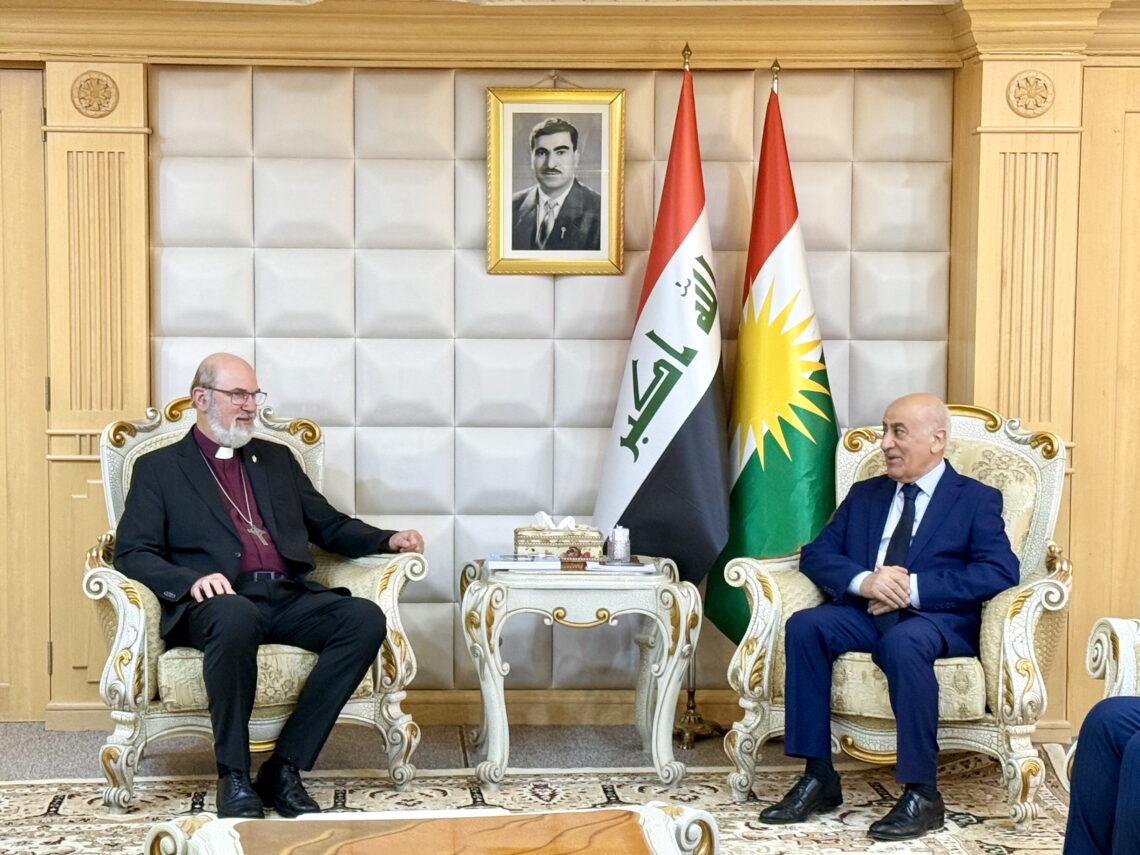
(Bonn, 09.03.2026) The President and the Secretary General of the International Society for Human Rights (ISHR) visited Kurdistan to learn more about the humanitarian aid work of the ISHR Kurdistan Section and to strengthen good relations with the Barzani Charity Foundation (BCF), ISHR’s most important cooperation partner in Kurdistan.
We provide four photo galleries of the visit:
- Kurdistan – Iraq – Religious leaders Muslims, Yazidis, Christians
- Kurdistan – Four ministers and the mayor of Erbil
- Kurdistan – Iraq – Refugee camps and the Barzani Foundation
- Erbil – Kurdistan – Iraq
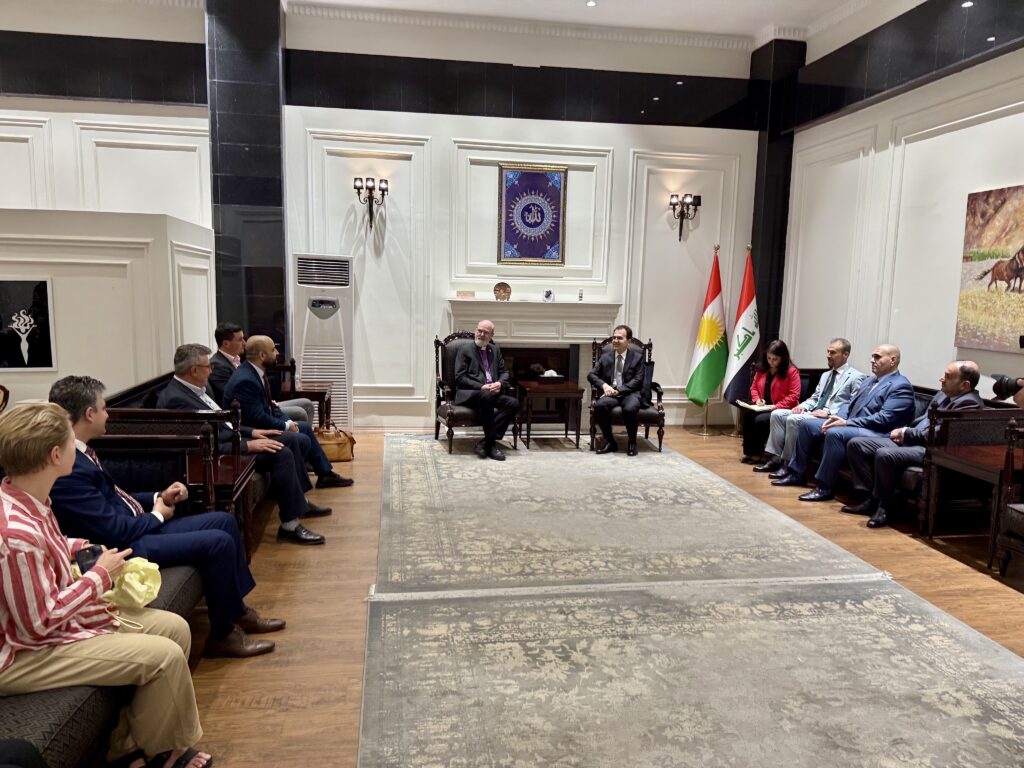
Immediately upon arrival in Erbil, President, Thomas Schirrmacher, and Secretary General Matthias Böhning were warmly welcomed at the airport by ISHR Country Director Dr. Krmanj Othman, the Coordinator for Humanitarian Aid in the Middle East of the German section of ISHR, Khalil Al-Rasho, and BCF employee Gulistan. From the airport, they went directly to their first appointment with H.E. Dr. Pishtiwan Sadiq, the Minister of Religious Endowment, which was interpreted by Dastan Abdulrahman Ali (responsible for relations in the Minister’s Office) and attended by Ameel Astefan Malham Hariri (Adviser to the Ministry of Endowments and Religious Affairs), Khalid Jamal Alber (Director General of Christian Affairs) and his colleague, the Director General for Yazidi Affairs, also took part.
During the meeting, attention was drawn to the current worsening plight of Christians in Kurdistan, who are suffering from the machinations of Rayan Al-Kildani, which include land grabbing. Al-Kildani is a Chaldean Christian from northern Iraq, born around 1975. He presents himself as a defender of Christians and in 2018 founded the Babylon Brigade (also known as the 50th Brigade or Kataib Babiliyoun), a militia under the umbrella of the Shiite Popular Mobilisation Forces (PMF/Hashd al-Shaabi). Despite its Christian name, the brigade consists largely of Shiite fighters from southern Iraq who are supported by Iran. Al-Kildani has close ties to Iranian influences (e.g. Quds Brigade) and was sanctioned by the US in 2023 for corruption, extortion and obstructing the return of displaced Christians. After the liberation of the Nineveh Plains from IS in 2017 (genocide of Christians and Yazidis), many of the approximately 120,000 displaced Christians did not return because militias such as the Babylon Brigade occupied land, houses and monasteries. The US describes Al-Kildani’s brigade as the ‘main obstacle’ to return, as it systematically loots and expropriates property—often under the pretext of ‘security’. This affects thousands of hectares in villages such as Qaraqosh, Karamles and the Nahla Valley, where Christians have been under pressure since the 1980s (e.g. from Kurdish or Shiite settlers). The ISHR President agreed to explore ways in which the ISHR could be of assistance, which was met with extreme gratitude by Dastan Abdulrahman Ali. For the otherwise respectable state of religious freedom in Kurdistan, the Al-Kildani case represents a real burden.
In the afternoon, the ISHR delegation, which included the President and Secretary General, Islamic scholar Dr. Esther Schirrmacher, and the personal assistant to the ISHR President, Martin Warnecke, who is also the editor of the Yearbook on Religious Freedom, visited the citadel of Erbil. The tour was organized by staff from the Barzani Charity Foundation (BCF), who also informed the delegation that the BCF is currently about to open its own history museum in the citadel. The day was rounded off with a dinner with BCF staff at the traditional Kurdish restaurant Qazuan.
Wednesday began with a visit to the Baharka refugee camp, where the ISHR delegation was welcomed by Botan, the coordinator for internally displaced persons (IDPs), and Abdulkadr, the camp manager (both BCF employees), who introduced them to the BCF’s work on site. It turned out that the camp is mainly home to families of former IS fighters.
The men/fathers are often imprisoned or dead, which exacerbates the neediness of the women and children left behind. The camp was opened in 2014 and, according to the camp management, still provides protection and accommodation for 181 families (865 people). The major challenge is to provide the internally displaced persons with the necessary services to which they are entitled according to humanitarian standards. According to BCF staff, the Iraqi central government in Baghdad is hardly concerned with the camp and the people living there anymore. Electricity and running water are available 24 hours a day. However, there are significant shortcomings in all other areas: food supply, hygiene, education and health. The central government has not supplied hygiene kits for more than two years, there is no primary health care station in the camp, and people have to go to nearby Erbil if they are ill or injured.
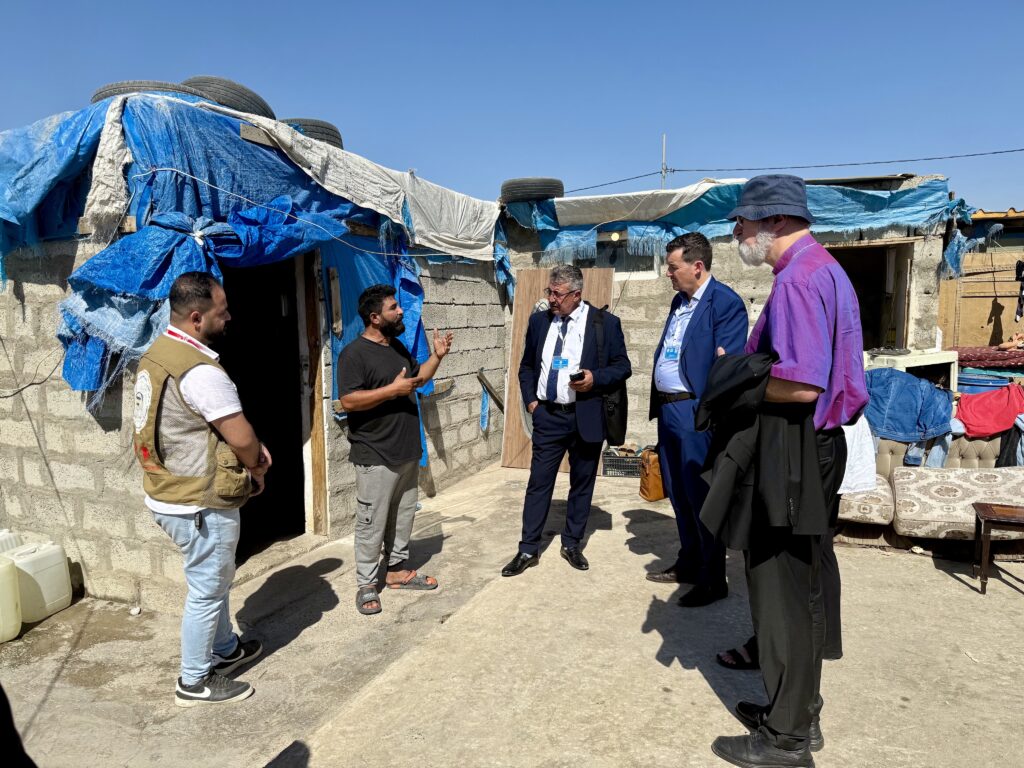
Furthermore, the few schools that exist have neither teachers nor writing materials. Interestingly, the camp is also home to Palestinian families who initially fled to the Mosul area many decades ago and sought protection in Camp Baharka as internally displaced persons after 2014. During their tour of the camp, the ISHR delegation met a middle-aged man who showed them his makeshift dwelling (consisting of brick walls and blue tarpaulins stretched tightly over them as a roof). He asked the delegation for financial support to replace the aging and worn roof, estimating the amount needed at the equivalent of around €80. The promise of aid was made immediately, with a request to Khalil Al-Rasho to ensure and monitor the actual provision of the aid.
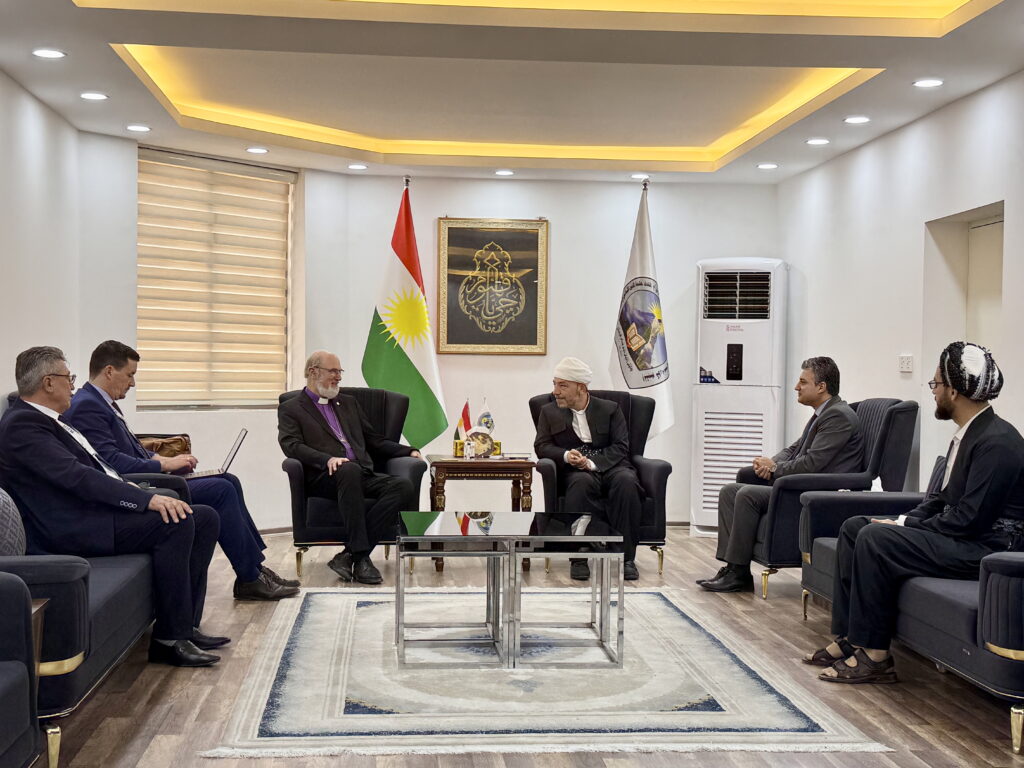
From the camp, the delegation proceeded to the Islamic Scholars Union, where they were received by its President, Mulla Abdulla Waisi. A lively theological discussion ensued between Archbishop Professor Schirrmacher and the Islamic scholar on the views of Islam and Christianity on the use of violence and on fighting religious extremism.
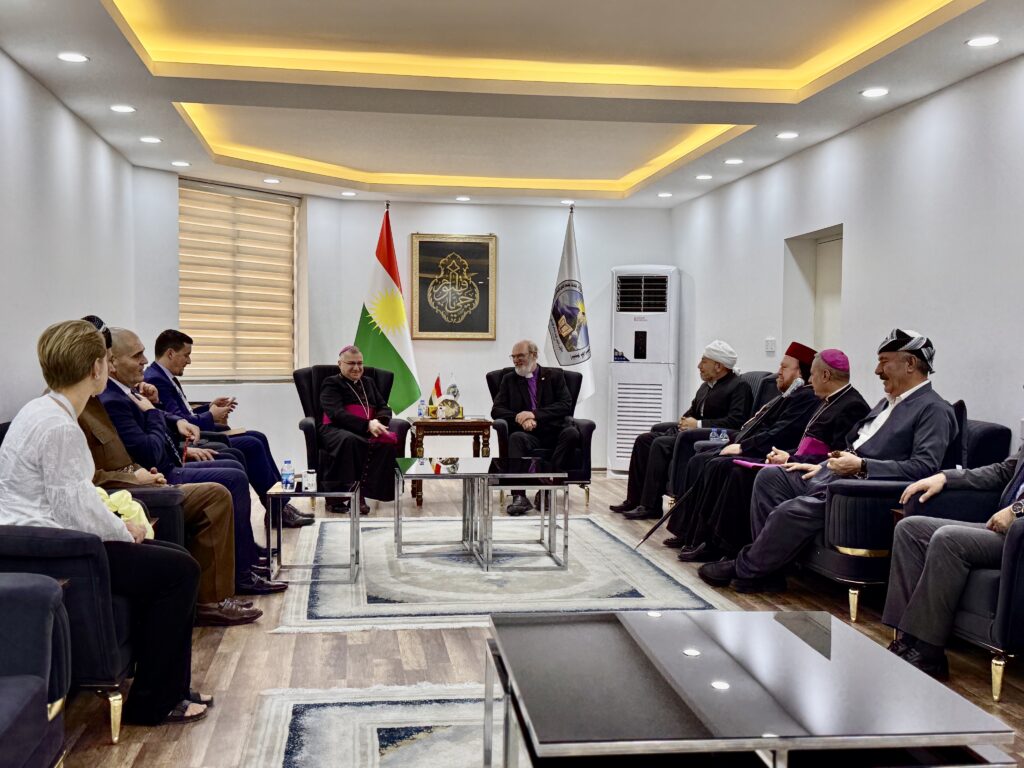
At the end of the meeting, a delegation of Christian leaders joined the meeting room to together congratulate President Mulla Abdulla Waisi on the 55th anniversary of the Islamic Scholars Union. Professor Schirrmacher knew all of the Christian leaders present personally, especially Roman Catholic Archbishop Warda and Syrian Orthodox Archbishop Nicodemus, so it was a joyful reunion.
Lunch was held at the headquarters of the Barzani Charity Foundation (BCF) at the personal invitation of BCF President Musa Ahmed, following an official reception at the BCF President’s premises, where Professor Schirrmacher thanked him on behalf of the ISHR for the many years of excellent cooperation.
After lunch, the BCF President asked Professor Schirrmacher to address about 150 BCF staff and trainees, who had gathered for their regular staff meeting in the event hall on the BCF premises. In his speech, the ISHR President emphasized the importance of faith-motivated and faith-strengthened commitment to human rights, which all BCF employees embodied in an ideal form through their daily work in various areas of the organization. The opportunity to give this speech was a further sign of the close and trusting relationship that has developed between ISHR and BCF over many years.
In the afternoon, the delegation visited H. E. Ano Jawhar Abdoka, the Minister of Transportation and Communications, at his office in Erbil. The minister is also the Representative of Christians at the Kurdistan Regional Government Council of Ministers. Herman Berwari, the General Director of Divan of the Ministry, and Dr. Jamal, the General Director of Communication and Postal Service, also attended the meeting. During the conversation, Minister Ano emphasized the long history of tolerance and coexistence that characterizes Kurdistan. He offered to be available to ISHR at any time as a source of knowledge and contact. He also spoke about the first National Prayer Breakfast, which took place in April 2025 under his co-hosting, and offered to invite ISHR representatives to the second edition in 2026.
Afterwards, the entire delegation set off for Dohuk to visit the Rabban Hormizd Monastery in Alqosh (a key pilgrimage site for Assyrians, Chaldeans, and Syriac Christians primarily associated with the Chaldean Catholic Church today, though it originated with the Church of the East (Nestorian tradition) and Lalish, the spiritual centre of the Yazidis, in the early evening hours. In Lalish, the delegation met with Baba Chauish, one of the highest spiritual leaders of the Yazidis worldwide, and during the conversation learned about the current status of the Yazidi community worldwide.
After returning to Erbil in the late evening, the ISHR delegation met with Kerstin Spriesterbach, who is responsible for the German development cooperation portfolio at the German Consulate General in Erbil. An important insight from the late-evening discussions on the terrace of the Radisson Hotel in Erbil was that the perpetuation of the refugee or internally displaced person status of the people in the camps in Kurdistan is increasingly becoming a problem, as the budgets for supplying and maintaining the camps are becoming increasingly limited due to recent global political developments (above all the dissolution of USAID by US President Donald Trump), while the prospects of return to their traditional settlement areas (for the Yazidis, above all the region around Sinjar) were deteriorating. To make matters worse, the (already meagre) return funds for the people in the camps have now been completely cancelled. The future prospects and the international donor strategy for long-term, sustainable stabilization of the situation in Kurdistan are therefore completely open and unclear. This must be made clear in a coherent and urgent manner by an influential player in the international diplomatic efforts of the world community with regard to Kurdistan and the activities of numerous states in the field of development cooperation, in order to ensure that the few resources available are used to bring about truly sustainable solutions for Kurdistan. At present, international cooperation with Kurdistan appears to be rather haphazard and aimless, or to put it more gently, ‘more of the same’.
On the last day of the delegation’s trip, Thursday, 25 September, the ISHR delegation visited H. E. First Ahmed, Minister of Justice of the Kurdish Regional Government. This visit to the ministry was of particular significance for the ISHR, as the ISHR Country Director in Iraq, Dr. Krmanj Othman, works as Senior Legal Advisor in the Ministry of Justice and also has his office there. The contacts with the Minister of Justice and his immediate staff are correspondingly cordial. Among other things, the ISHR’s willingness to translate legal texts from Germany and other countries into Arabic and make them available to the Ministry of Justice for further use was discussed.
The delegation then visited H.E Omed Xoshnaw, the Governor of Erbil, in his government building. In addition to the Governor’s staff, Naz Jalal Saleem, Director of Migration and Crisis Response for the Erbil Governorate, also took part in the meeting. The Governor expressed his deep gratitude and enthusiasm for the work of the ISHR in cooperation with the BCF and thanked them profusely, presenting the ISHR President with a special gift: a high-quality, framed miniature view of the Citadel of Erbil. The Citadel can be seen directly from the entrance of his palace.
The governorate assured ISHR representatives that they could contact the governorate at any time with any questions or requests and that every effort would be made to assist them. This is primarily the result of the many years of high-quality work carried out by Dr. Krmanj Othman and Khalil Al-Rasho. During the visit to the governor, the ISHR president emphasized that this was Khalil Al-Rashos 46th delegation trip to Kurdistan, which illustrates the scope of the work he has done over many years.
Finally, on the way to the airport, a visit was made to Dr. Dlovan M. F. Jalal, Director General of Health for Erbil at the Ministry of Health of the Kurdistan Regional Government. Dr. Dlovan is a long-standing friend and companion of the ISHR’s work, who has already attended the annual conference of the German section of the ISHR twice. During the 2023 annual conference he honored Thomas Schirrmacher with a special medal. He is currently running for the Iraqi National Parliament and hopes to win a seat in the elections taking place in November. He also promised to continue to support the work of the ISHR in Kurdistan to the best of his ability, for which the ISHR President and ISHR Secretary General expressed their sincere thanks.
Downloads and Links
- Photo 1: Thomas Schirrmacher with H. E. First Ahmed, Minister of Justice of Kurdistan © ISHR
- Photo 2: Minister of Religious Endowment of Kurdistan, H. E. Dr. Pishtiwan Sadiq, and his major directors with joint delegation from ISHR and Barzani Foundation © ISHR
- Photo 3: Archbishops delegation of different churches at the Islamic Scholars Union in Erbil Kurdistan © ISHR
- Photo 4: Islamic Scholars Union President Mulla Abdulla Waisi with Thomas Schirrmacher and ISHR delegation on the 55th anniversary of the Union © ISHR
- Photo 5: Lalisch Baba Chauish and Thomas Schirrmacher in the central sanctuary of the Yazidis in Kurdistan © ISHR
- Photo 6: Baharka refugee camp in Kurdistan © ISHR
- Website of the International Society for Human Rights (ISHR): https://ishr.org

