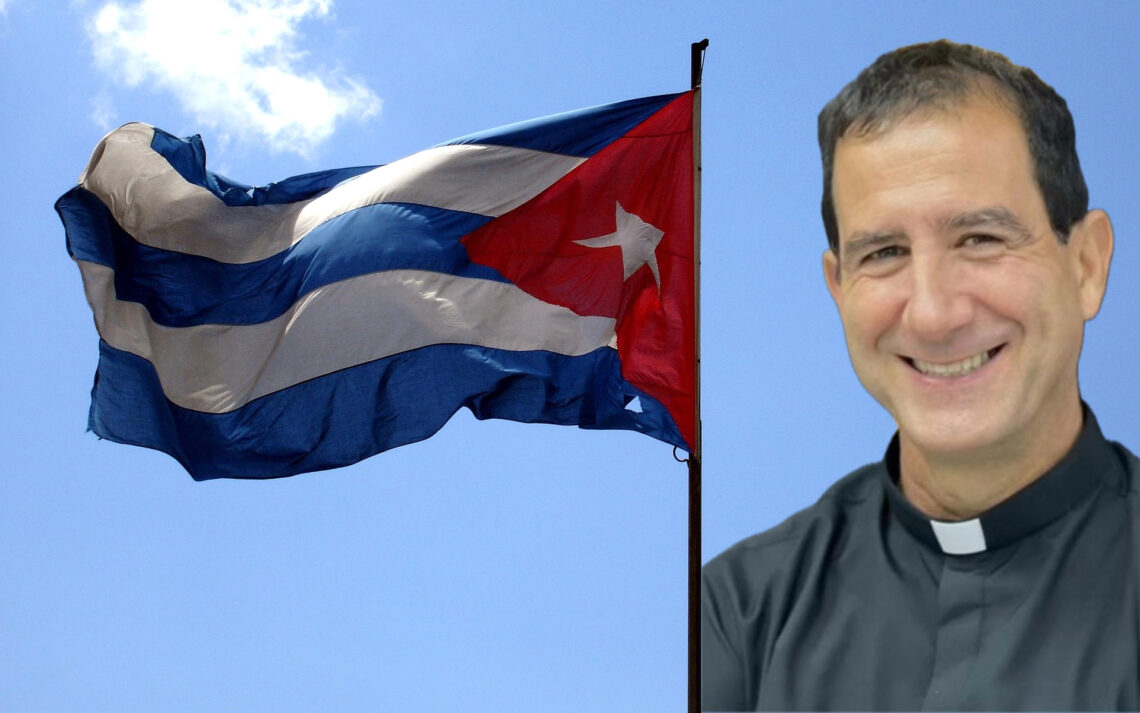
A Cuban priest caught between the pulpit, dissent, and imposed silence – by Angel Suares Sanchez*
(Bonn, 06.02.2026) Amidst the tensions between church and state in Cuba, Father Alberto Reyes Pías has emerged as a leading critic of the ruling system. His sermons and publications reflect the national crisis and resonate with an exhausted population. Threats, imprisonment, attempts to divide the church, and character assassination have proliferated as the government, which is not legitimized by the population, uses old and new strategies to curb the influence of religious communities.
In a country where the public sphere has been monopolized by one party for six decades, the emergence of criticism from unexpected quarters takes on extraordinary significance. This critic is neither a professional politician nor an established opposition leader. He is a Catholic priest who speaks slowly and firmly. He has become one of the most uncomfortable figures for the Cuban government from his parish in Camagüey and, more recently, from prison and under house arrest.
Participation in the protests of July 11, 2021
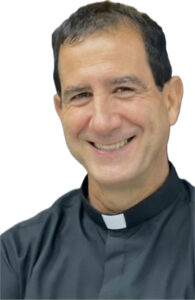 Born in 1966 and ordained a priest in 1995, Reyes was not always the dissenting voice he is today. For years, his ministry remained within the narrow limits imposed on religions by the socialist state. However, a turning point marked his life: his participation in the protests of July 11, 2021 (11J). Since then, his public discourse has changed. He no longer limits himself to spiritual sermons; instead, he has begun to denounce, with names and details, the socioeconomic and political reality that he believes oppresses the Cuban people.
His tools are simple but effective: sermons recorded and published on social networks (mainly by collaborators, as he has limited access) and open letters. In them, he does not speak in abstract terms. He denounces the misery of wages, the notorious shortages, the repression of peaceful demonstrators, the existence of political prisoners, and the double standards of a leadership that, he notes, lives in privileged conditions while the people suffer. His criticism is comprehensive, covering topics from economic inefficiency to the basis of the one-party system, which he describes as “totalitarian.”
He breaks the silence
The relevance of Father Reyes lies in several interrelated factors. The first is his moral credibility. It comes from an institution, the Catholic Church, which, despite all its vicissitudes, has retained a significant level of respect in Cuban society. He is not an external actor; he is a shepherd who claims to share the suffering of his flock.
The second factor is his direct and courageous language. In an environment where fear of punishment stifles opinions, his willingness to call things by their name—even when referring to President Miguel Díaz-Canel—breaks a huge taboo. It acts as a decoder of official reality. While state media speak of the blockade as the sole cause of all evils, Reyes points to mismanagement, lack of freedoms, and corruption as intrinsic factors.
Third, his message articulates the unease of the population. He does not invent the crisis; he puts into words the hunger, despair, and frustration that millions of Cubans experience every day. His preaching provides a framework for understanding and, for some, ethical legitimation of their discontent.
It is difficult to measure Reyes’s exact influence in a society with limited internet access and under police control. However, there are indications that his resonance is considerable. His videos circulate from phone to phone via messaging apps such as WhatsApp or Telegram, in a modern form of “stick journalism.” They are shared not only by believers but also by Cubans of all religious backgrounds who see him as a sincere spokesperson.
On the streets, his name elicits mixed but intense reactions. For one sector, he is a prophet or martyr who speaks the truths that many think but dare not say. For others, both inside and outside the church, he is a reckless man who politicizes his ministry and jeopardizes the fragile coexistence between the church institution and the state. The government, for its part, labels him a “counterrevolutionary,” “mercenary,” and “agitator in the service of the United States.”
Arrest after sermon
Reyes’s re-arrest in February 2023, after a particularly critical sermon, and his subsequent sentencing to one year and eight months of house arrest (a sentence he has already served, according to his relatives, but which is being maintained unofficially) have only reinforced his symbolic profile. The direct repression against him confirms to his followers the validity of his accusations.
Father Reyes’s actions cannot be understood outside the historical context of the relationship between the Cuban state and religions. After a period of open hostility in the 1960s and 1970s, a slow process of détente began, culminating in the visit by Pope John Paul II in 1998 and the constitutional recognition of the secular state in 1992. However, coexistence never meant complete freedom.
To neutralize the influence of church leaders who defy official history, such as Reyes, the government employs an arsenal of tactics that combine coercion with bureaucratic control:
Surveillance and control: Religious institutions and their leaders are under strict surveillance by state security. Meetings and activities are monitored. Infiltrated agents report on the content of sermons.
Division and co-optation: New foundations are encouraged and loyal or apolitical religious associations are given preferential treatment. Attempts are made to divide communities by pitting “docile” leaders against “problematic clergy.” Selected members of religious orders are invited to official events to project an image of inclusion.
Bureaucratic and legal restrictions: The granting of permits for the construction or repair of places of worship or for the holding of public processions is subject to complete political arbitrariness. The Association Law and the Regulations on Religious Worship give the state absolute discretion to legalize or not legalize any group. Criminal law provisions are being misused to persecute religious dissidents.
Discrediting campaigns: The state media attacks figures such as Reyes and links them to “imperialist subversion.” The government denies any pastoral or ethical motivation, portraying them as political actors.
Pressure on the hierarchy: The Cuban leadership puts pressure on church leaders, especially the Catholic Bishops’ Conference of Cuba, to control their most critical members. This creates internal tension within religious institutions themselves, between the diplomatic prudence of the hierarchy and the prophetic zeal of grassroots pastors.
The case of Father Alberto Reyes is much more than the story of a rebellious priest. It is symptomatic of a civil society hungry for authentic voices and a regime that has lost all moral legitimacy for a growing segment of the population. His perseverance, even in prison, shows that faith, when translated into a commitment to justice, can become a foundation for impressive peaceful resistance.
As the economic and migration crisis worsens, the message articulated by Reyes—and by various evangelical clergy and other religious leaders who are also subject to state pressure, albeit with less visibility—continues to find receptive ears among the population. The Cuban authorities, entrenched in a model of total control, seem confident that threats, isolation, disqualification, and coercion will be enough to silence these and other voices. But in today’s Cuba, where disillusionment is widespread, enforced silence could actually fuel an outcry that is much more difficult to quell. Father Reyes’s peaceful struggle is not for his personal freedom, but for the right of an entire people to have a voice and speak out about the Cuban reality without fear.
* The author reports on everyday social and political life in Cuba as an ambassador for human rights. He is a committed Protestant Christian and lives in Santiago de Cuba. After many years of professional activity in the civil service, he was barred from further professional activity because he had campaigned for the release of prisoners who had peacefully participated in the protests of July 11, 2021.
About Father Alberto Reyes Pías
By Elena Larrinaga (President of the Cuban Christian Democratic Party)
Father Alberto Reyes Pías is a Cuban Catholic priest and pastor in Camagüey. He is known for his public reflections on social media, in which he addresses Cuba’s social and political reality from the perspective of faith and civic consciousness.
He is repeatedly summoned for interrogation and threatened. But he has stated: “It is time to overcome fear and continue to demand our rights.” Reyes does not limit himself to spiritual messages, but appeals directly to people’s sense of responsibility, the defense of their rights, and the need for profound change in the country.
Father Alberto is under constant surveillance. He has been admonished by a faction within the Catholic Church in Cuba that does not consider it advisable to advocate openly for regime change, as it fears that—as has often been the case throughout the history of the revolution—its hard-won positions could be undermined. The survival of the Catholic Church in Cuba has always been marked by complex relations with political power. The “recommendations” to Father Alberto are typical and urge him to remain silent, as otherwise there could be serious consequences.
In his latest reflection, the priest begins with a feeling shared by many Cubans today: the hope that, after recent events in the region, particularly in Venezuela, real change can take place. “It is time to overcome fear and continue to demand our rights,”he says.
He is a truly courageous person, because he knows that the Cuban church as a whole is incapable of acting and that the consequences of his words could be very serious and harsh for him. We are grateful for his words, which give courage and confidence to the Cuban people.
Downloads and Links
- Photo: Pater Alberto Reyes Pías © privat

